
The Hollowing of the Experienced Immigration Judge Corps and Risks to Due Process
April 2026
by Savannah Estridge

During the first year of Trump’s second term, the number of permanent, active immigration judges (IJs) hearing cases in U.S. immigration court plummeted, all while the rate of asylum denials continued to increase. More than 100 IJs were dismissed, and government data analyzed below suggests that the net decline has been significantly more than that. These experienced IJs have in part been replaced by appointing military attorneys and other Temporary Immigration Judges (TIJs), no longer required to have experience in immigration court. That means that fewer experienced IJs are making more potentially life-altering decisions about whether people are allowed to remain with their families and in their communities or be deported.
As the analysis below shows, the number of permanent IJs hearing cases peaked by the end of the Biden administration but has collapsed since. Not surprisingly, during the same period the asylum denial rate skyrocketed, while the asylum grant rate plummeted.
Immigration judges are appointed by the U.S. Attorney General to preside over formal court proceedings in the more than 70 immigration courts across the United States. These judges are civil servants considered part of the executive branch within the Department of Justice and work under the direction of the Attorney General. They preside over removal proceedings to determine if a noncitizen will be ordered removed from the United States. In addition, they preside over applications for relief from removal, such as asylum, withholding of removal, and protection under the Convention Against Torture (CAT). These judges are tasked with ensuring due process by providing fair hearings, where they conduct an in-depth, individual analysis of each person’s case before deciding whether to grant relief or to order their deportation.
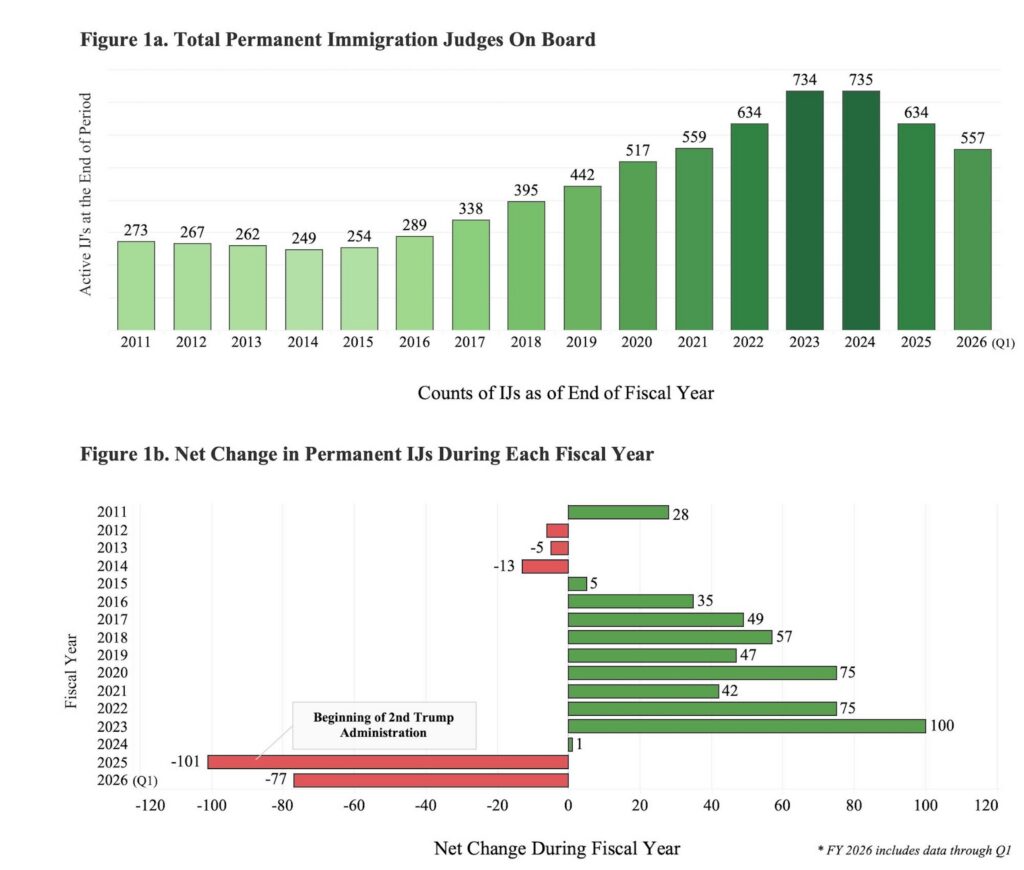
Immigration judges completed over 900,000 cases during fiscal year 2024 (FY2024),i and as of the end of FY2024—the final report covering the Biden administration—735 immigration judges were on-board atthe Executive Office for Immigration Review (EOIR), the office that oversees the federal immigration court system.ii The number of active, permanent IJs has fallen by a quarter during the first year of the second Trump administration. Specifically, as December 31, 2025—the most recent date for which EOIR has reported data—there were 557 active immigration judges, a net loss of 178 permanent judges since the end of FY2024.iii This loss of judges occurred amid a backlog of over three million cases within the immigration court system.
In September 2025, the Trump administration announced that up to 600 military lawyers would be authorized to serve as temporary immigration judges for the Justice Department. According to an estimate published by the New York Times, some 143 temporary and permanent IJs have been hired during the Trump administration and, as of this writing, the EOIR website listed 650 IJs—both temporary appointments and permanent hires. These temporary judges are no longer required to have prior experience in immigration courts. Immigration advocates have raised concerns that replacing experienced immigration judges with military lawyers who do not specialize in immigration law puts individual due process at risk in this system. It is evident that the current Administration utilizes immigration judges to advance its enforcement agenda, rather than as agents of an impartial adjudicatory body. This is made all too clear on the DOJ website where recruits are invited to “[h]elp write the next chapter of America. Apply today to become a deportation judge.”

Source: Department of Justice
The number of IJs working in immigration court had increased steadily for several years, from 254 judges in September 2015 (end of FY2015) to reach a peak of 735 by the end of FY2024 (see Figure 1a), and likely more by the start of the Trump administration. However, as noted above, this growth reversed and continued to fall as we approached the end of the first full year of the second Trump administration at the end of December 2025 (the most recent date for which these data are available). Specifically, EOIR reports that as of the end of Quarter 1 of FY2026 (Q1 FY2026), there were only 557 permanent, active immigration judges. That’s a net loss of 101 IJs during FY2025 and 77 more in Q1 FY2026, or as of December 31, 2026 (see Figure 1).iv
During the same period (Q1 FY2025 and Q1 FY2026), according to Transactional Records Access Clearinghouse (TRAC) data, the number of asylum case completions increased dramatically, reaching a peak of 35,958 cases in Q3 of FY2025, an 114.9% rise.
Fewer total asylum cases were completed in Q1 FY2026 (25,943) than in Q3 or Q4 FY2025 (35,958 and 31,384, respectively). However, the number of asylum denials surged by 74.3% in Q1 FY2026, from 12,509 denials in Q1 FY2025 to 21,806 a year later in Q1 FY2026 (see Figure 2a).v At the same time, asylum approvals began to decline during the last few months of the Biden administration and plummeted dramatically during the first year of the Trump administration. Specifically, approvals for asylum relief dropped from 7,070 in Q1 FY2025 to just 3,403 in Q1 FY2026, a 51.87% shift.
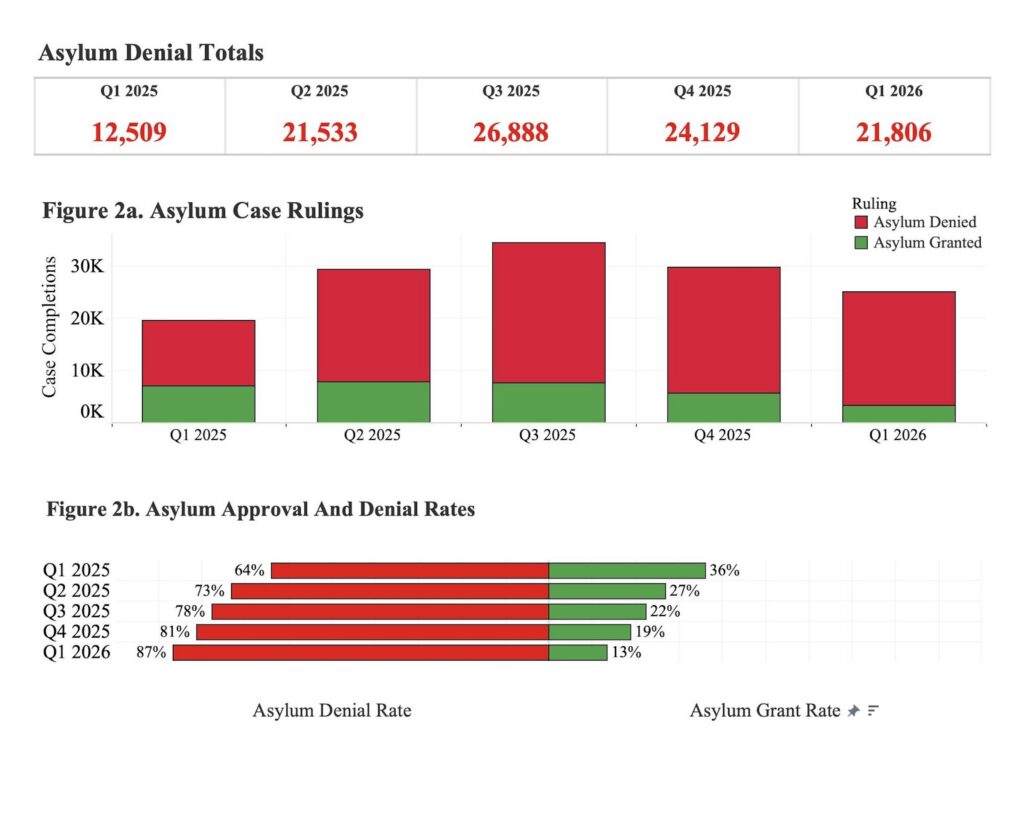
This stark contrast reveals the consequences of this piece of the current Administration’s policy. As the experienced IJ corps has been hollowed out and filled with less experienced “deportation judges” and more cases are processed, it is getting harder for individuals to obtain relief in the U.S. as an increasing proportion of claims are denied. Such a widening gap raises serious concerns about whether due process is being compromised, as judges face mounting pressure to resolve cases quickly. This environment that prioritizes expediency and denial above the careful evaluation of the merits of each case, risks undermining every person’s right to their day in court.