What is ICE and have they always been so aggressive?

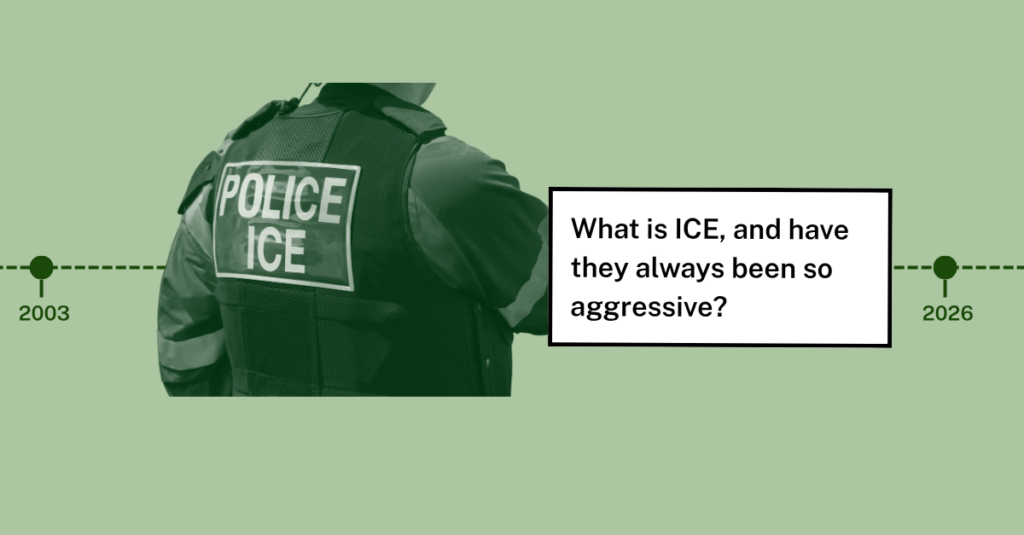
What is ICE, and have they always been so aggressive?

ICE has been all over the news. You may have seen ICE agents patrolling your neighborhood or even acting as airport security. ICE agents have a reputation for being undertrained and violent, and for targeting communities based not on data, facts, or credible threats, but on arbitrary quotas and disinformation that are politically charged, racist, and unjust. ICE has been given an enormous budget and seemingly unlimited permission to surveil and detain people with total immunity. They have acted far outside of their intended role of immigration enforcement, targeting citizens who get in their way or who hold political beliefs they don’t agree with. This can feel overwhelming, frightening, and you may be asking what is ICE? What is the history of ICE in America? Where did ICE come from, and what are ICE agents supposed to be doing?

Across Acacia programs, we see the direct impact of ICE’s enforcement role every day. These enforcement trends shape the daily reality of the people we serve. Through initiatives like the National Qualified Representation Program (NQRP) and the Family Reunification Program (FRP), our networks work with people who are currently in ICE detention or navigating its consequences from prolonged detention to family separation. Also, in response to the escalating tactics of ICE, Acacaia created our National Immigration Legal Responders Alliance, Habeas Bridge Project, and Witness for Justice court watch initiative. To understand how we arrived at this moment, it helps to understand how ICE was created and how its role has evolved over time.

Contrary to popular belief, ICE hasn’t always been around, and they haven’t always been this aggressive. In this explainer, we have answers to your most frequently asked questions about ICE.

FAQ: Where did ICE come from? What are the origins of ICE in America?

The United States Immigration and Customs Enforcement, also known as ICE, is a relatively new agency, established only in 2003. In the wake of 9/11, the federal government underwent a major reorganization. The harmful stereotype that immigrants are criminals existed long before 9/11, but after 9/11, this stereotype escalated from crime to terrorism. This core idea that immigrants are potential terrorists has had lasting impacts on the funding and function of immigration enforcement and treatment of immigrants in America. 

Prior to 9/11, all matters related to immigration were handled by The Immigration and Naturalization Service (INS) under the Justice Department, and the United States Customs Service (USCS) under the Treasury Department. The immigration system in America had been long overdue for an overhaul, and on September 6. 2001, a major positive shift was on the horizon. America and Mexico had actually agreed on a framework for reform and declared that “U.S.-Mexican relations have entered their most promising moment in history.” The attacks a few days later derailed this effort, and attempts to reignite it have failed, even over 20 years later.

In 2002, with a renewed focus on immigration enforcement as a tool of counterterrorism, the Homeland Security Act transferred most of the functions of the INS and USCS to three new entities under the newly created umbrella of the Department of Homeland Security (DHS): 

  • United States Citizenship and Immigration Services (USCIS): the federal agency that oversees immigration to the United States. They are responsible for things like visa petitions, naturalization applications, asylum applications, applications for adjustment of status (green cards), and refugee applications.
  • U.S. Customs and Border Protection (CBP): the federal agency that oversees the border. They are responsible for preventing illegal border crossings and enforcing U.S. regulations around international trade.  

U.S. Immigration and Customs Enforcement (ICE): the federal agency responsible for immigration enforcement within America’s border.

FAQ: What is ICE and what are they supposed to do?

The stated mission of ICE is to “protect America through criminal investigations and enforcing immigration laws to preserve national security and public safety.” ICE agents and officers are focused on the interior, or inside America’s borders. ICE is made up of two parts: Homeland Security Investigations (HSI) and Enforcement and Removal Operations (ERO).  

  • Homeland Security Investigations (HSI) is focused on transnational crime. Transnational crimes involve more than one country in the planning, execution, or impact of the crime. For example, drug or weapons trafficking, human trafficking, fraud, and money laundering fall into this category.
  • Enforcement and Removal Operations (ERO) is focused on enforcing federal immigration law. They identify, apprehend, detain, and deport noncitizens.

FAQ: Has ICE always been this aggressive?

ICE existed under the Bush, Obama, Trump, and Biden administrations. While there have been significant levels of deportation under Bush, Obama, and Biden, immigration enforcement is the most aggressive it has ever been in modern history under Trump’s second presidency. 

For about a decade, ICE’s budget hovered around $6B-$10B per year. Under President Trump, ICE has become the largest and most well-funded federal law enforcement agency in U.S. history, receiving $90B last year, with Senate Republicans pushing for even more. With such rapid growth, the way ICE has operated has become more controversial, more reckless, and more violent, resulting in a culture of fear and mass surveillance of noncitizens and citizens alike. 

There is grave concern about the rapid recruitment of ICE agents, their fitness for the role, and the little training they receive. Investigative journalist Laura Jadeed reported being hired after only six minutes without completing any background paperwork at an ICE career expo. Without a serious vetting process and in light of the white supremacist tropes featured in their recruitment advertisements, it’s no surprise that the Washington Post reported that some ICE agents have ties to white supremacist groups. Despite these valid concerns about their competence and ethics, there has been a shift toward absolute immunity for ICE officers, which means they will not be held accountable for their actions, as lawsuits are dismissed without the investigative discovery phase. This lack of accountability, vetting, and training is just one piece of the puzzle that makes ICE more aggressive overall. 

ICE officers also have access to a wide range of surveillance tools, like facial recognition, to identify immigrants for potential detention and citizen observers, and they have adopted raid-style tactics to broadly sweep people into detention. In 2026 alone, ICE has detained over 60,000 people, almost twice as many as those detained under Biden and Obama. Unlike previous administrations, there is seemingly no discretion in who is detained. Instead of targeting specific enforcement priorities, ICE is now detaining pregnant and nursing women, families, and 86-year-old women with no criminal history. 

The rapid and widespread growth of for-profit ICE detention centers has been alarming. Even though being undocumented or overstaying your visa is not a criminal offense (it is a civil violation akin to a traffic violation), people who are waiting for the decision on their immigration status are often incarcerated in immigration detention centers in terrible, jail-like conditions. Some people have experienced solitary confinement, starvation, and abuse, and deaths in ICE detention have not been this high since 2004. Some people have entered ICE detention and vanished from the ICE locator system entirely. Some people have been disappeared to countries like El Salvador, without an opportunity to notify relatives, speak to a lawyer, or fight the removal. On multiple occasions, ICE has even deported people in violation of federal court orders.

This escalation is reflected in the growing number of people that Acacia’s programs serve in ICE detention facilities and the increasing barriers they face in accessing counsel, connecting with family, or meaningfully participating in their case. 

The threat of encountering ICE agents and being disappeared has made many people withdraw from public life for fear that they will be targeted. This fear has led some people to be too afraid to call the police or an ambulance when they need help. ICE has a history of detaining people as they show up for their scheduled immigration court hearing, making it an impossible choice to follow the law or get detained. Through Acacia’s Witness for Justice court observation project, court observers have documented ICE activity in and around immigration courts, including patterns of enforcement that undermine access to due process and that discourage people from attending their hearings. ICE has created a culture of fear that makes communities less safe for everyone and more difficult for people to adhere to their legally required immigration court schedule.

FAQ: Am I safe from ICE in school, at church, or at the hospital?

For years, there were places known as ICE “Sensitive Locations.” These are areas where ICE would avoid immigration enforcement, like schools, hospitals, places of worship, healthcare facilities, playgrounds, funerals, weddings, and courthouses. In January of 2025, the Trump administration changed this rule and removed these protections. This means that ICE can enter these locations, but you still have rights

Depending on where you live, you may have additional protections in place. 

FAQ: How can I protect myself and my community?

  • Know your rights! Laws are always changing. Stay up to date with protections in your city and state.
  • Make a plan. Download the ReadyNow! app to prepare for the worst, just in case. Instantly notify trusted contacts and legal aid if you are faced with arrest, and ensure your support network has the information they need to respond, fast.
Want to learn about your rights if you encounter ICE?