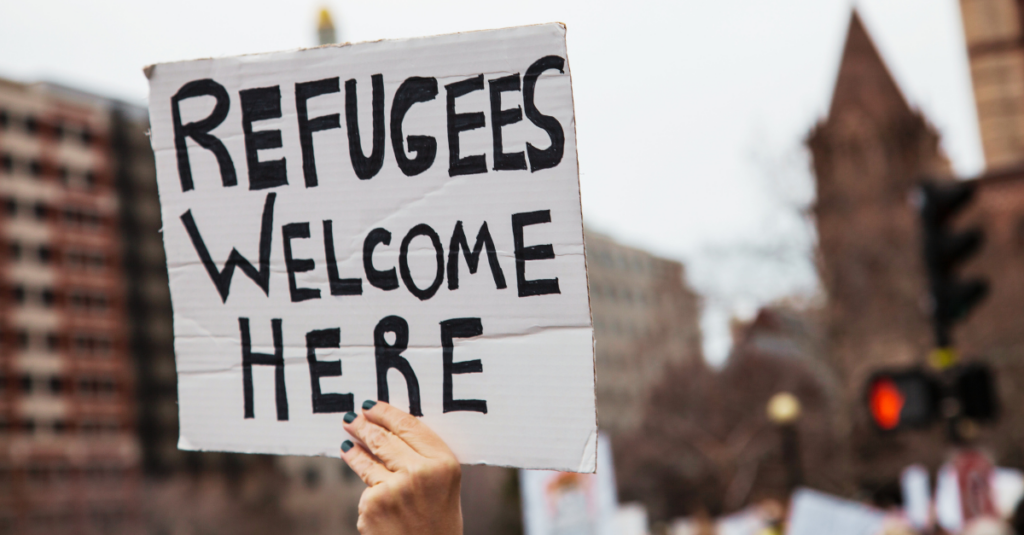
Refugees welcome here

The promise of the 1951 Refugee Convention

In a time of rising nationalism and global tensions, it can be difficult to imagine a world where leaders worldwide agreed on a fundamental question of our humanity: what do we owe to people forced across borders by violence?  

Seventy-five years ago, when an estimated 50 million people were uprooted by the war, genocide, and political upheaval in the aftermath of World War II, the global community answered this fundamental question with the 1951 Refugee Convention. The Refugee Convention is an agreement to not forcibly return anyone to a country where they face persecution. It also established basic rights and dignity for those who reach safety. Today, we have just as many people fleeing across international borders in search of safety, but countries are pulling back from the Refugee Convention and leaving people’s lives dangling in the balance. We must, as an international community, recommit to our shared humanity of the 1951 Refugee Convention.

What is the 1951 Refugee Convention?

Today, 149 States are signed on to the 1951 Refugee Convention. The core principle of the Refugee Convention is nonrefoulement, or the agreement that a refugee should not be returned to a country where they face serious threats to their life or freedom. 

The 1951 Refugee Convention established the internationally recognized definition of a refugee: A person “owing to well-founded fear of being persecuted for reasons of race, religion, nationality, membership of a particular social group or political opinion, is outside the country of [their] nationality and is unable or, owing to such fear, is unwilling to avail [themself] of the protection of that country.”

The Refugee Convention outlines how refugees should be treated. This includes basic minimum standards of legal protection, rights, and assistance a refugee is entitled to receive, such as the right to housing, work, and education while displaced so they can lead a dignified and independent life. It also states a refugee’s obligations to the host country and specifies certain categories of people, such as war criminals, who do not qualify for refugee status.

The Trump administration is breaking the promise of the 1951 Refugee Convention

At the end of 2025, almost 118 million people worldwide were forcibly displaced, including more than 50 million people who fled across international borders. Behind this statistic are people stuck in limbo in refugee camps, families broken apart, kids who just want to go back to school, and individuals navigating immense grief and rebuilding their lives after loss. 

The promise of the 1951 Refugee Convention is still as relevant now as it was 75 years ago. The Trump administration is breaking those promises, with echoes of the nationalist ideology that drove the very war that the 1951 Refugee Convention was born out of. The Trump campaign ran on a cruel, anti-immigrant platform of mass deportations. Refugees have been swept up into this nationalist fervor, with unprecedented cuts to refugee programs. 

Shortly after the inauguration in 2025, the Trump administration indefinitely shut the border to asylum seekers and signed an executive order to freeze all refugee processing. The refugee program was restarted in October of 2025 with a historically low annual cap of 7,500 refugees. To compare, the annual target of resettlement was 125,000 under the Biden administration, and 110,000 under the Obama administration. Under the historic low cap under Trump, white South Africans were prioritized in a move described to “end white genocide,” a claim which has been fact checked as completely false. This decision stunned lawmakers, with Gregory Meeks of the House Foreign Affairs Committee describing it as “not just a racist dog whistle, it’s a politically motivated rewrite of history”. 

In addition to the low cap for new refugees, in November of 2025, the Trump administration destabilized the 200,000 refugees already admitted during the Biden administration, by suspending applications for permanent status, and requiring each person to undergo a new review and potential re-interview. In a targeted political move against the state of Minnesota, the Department of Homeland Security reopened the cases of refugees in Minnesota and declared it would arrest and detain refugees who are lawfully in the country but do not have a green card. 

These actions undermine the internationally recognized protections for refugees and basic standards of dignity and life outlined in the 1951 Refugee Convention – and they are wildly unpopular. A strong majority of Americans, nearly 70%, support the U.S. having a refugee program. 

Recommitment during a time of strain

America is not alone in its retreat from the 1951 Refugee Convention. The International Rescue Committee found that among the Convention’s original signatories and beyond, humanitarian funding fell by more than $31 billion in 2025 and global resettlement commitments dropped by more than half. Governments are cutting refugees’ path to permanent status, capping integration programs, and scaling back resettlement commitments. 

The IRC’s report outlines three ways that the global community can recommit to the 1951 Refugee Convention: 

  • Support Well-Functioning Asylum and Reception Systems: Properly resource and fund refugee determination and reception programs, guarantee legal assistance and protections for vulnerable groups, allow applicants to work during adjudication, and use fast-track processing for well-founded claims to free up resources for more complex cases.
  • Make Smart Investments in Durable Integration: Replace temporary, revocable status with clear, predictable pathways to permanent residence and citizenship, and invest early in workforce integration, credentialing, and access to credit. 
  • Recommit to Global Cooperation: Countries in the Global North should make and keep pledges under the Global Compact on Refugees and the EU’s Union Resettlement Framework, reverse cuts to humanitarian aid, and expand concessional financing for the low- and middle-income countries hosting 68% of the world’s refugees.

As a global community, the 1951 Refugee Convention was a moment of commitment to shared humanity. There is too much at stake to let this commitment fall apart.