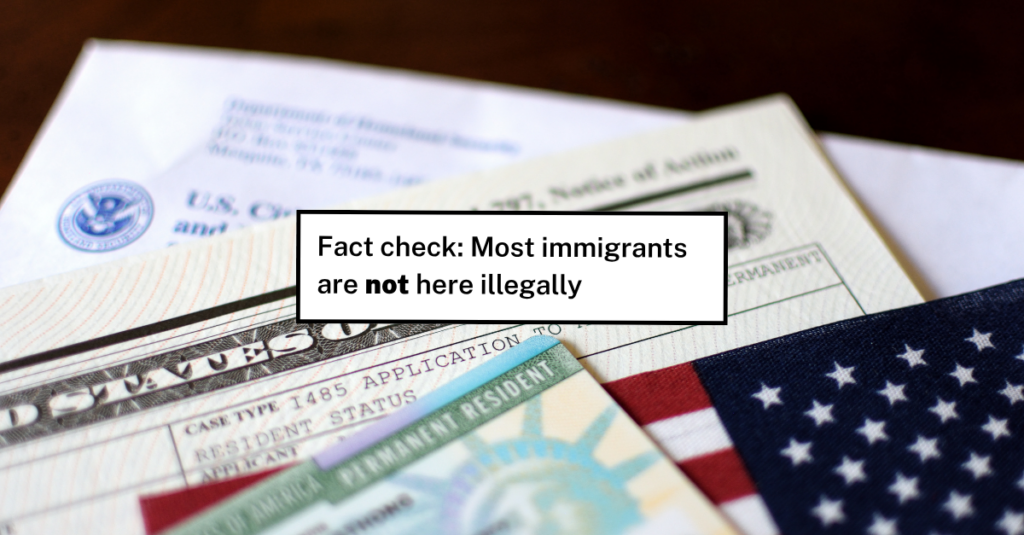
What you may have heard
One of the most widespread narratives about immigrants in America is the false claim that the majority of immigrants are here illegally. This claim is not only incorrect, it also loses the critical nuance of why someone would not have legal status. Oftentimes, this narrative of illegality is being used to prop up a “tough on crime” policy agenda. By lumping immigrants with criminals, an assumption that is categorically false, pathways for swift, harsh deportations are created. In this article, we outline what it means to not have legal status, how often people actually are here illegally, and the impact of this false narrative.
First, let’s define what illegal immigration means. While you may hear the term “illegal immigrant” in the news, Acacia Center for Justice does not advocate for the use of such dehumanizing terms, and prefers the term undocumented. Undocumented is also a more accurate term, considering some immigration pathways require people to be inside the U.S. and stay there while their immigration cases are processed before status can be granted. Said another way, the formal process asks people to wait in the U.S. while their claim for documentation is processed, then asks them why they didn’t have documentation to be in the U.S. while they waited. It’s a flaw in the system itself.
Someone who is undocumented resides in the United States without legal status, which can happen in a variety of circumstances. This includes those who:
- Entered Without Inspection (also known as “EWI”): At the border, there are official checkpoints for inspection to obtain permission to enter the country. Those who entered without inspection did not visit these checkpoints.
- Entered with Legal Status but Overstayed: Individuals who entered the United States with legal status, like those with a student visa, and then remained in the country after their ‘duration of status’ date or after their visa expired.
- Have or Previously Had Deferred Action for Childhood Arrivals (DACA): Individuals who have been granted temporary reprieve from deportation through the federal government’s Deferred Action for Childhood Arrivals (DACA) program.
- Are Currently in the Process of Legalizing: Individuals who are pursuing legalization (e.g. U.S. Citizen Spouse Petition, Asylum petition, or U-visa pending, etc.) but currently have no legal status. This process can take a very long time to complete.
- Are Vulnerable Immigrants: Individuals whose immigration status is in ‘limbo’ puts them ‘at-risk’ for being targeted by immigration enforcement. This could occur due to many factors, such as politics (e.g. TPS program is at risk due to policy shifts), technicality (e.g. your status lapsed because the government was too slow to process your renewal, or has suddenly paused processing for your country), or personal circumstances (e.g. a U-visa recipient who cannot adjust their status because theylack the funds, or missed a deadline).
There are many reasons why a person may not have full legal status, and it often takes years to process an application. The immigration system is notoriously complex, nearly impossible to navigate without a lawyer, costly, and constantly changing. During the Trump administration, an aggressive enforcement agenda has resulted in confusion and the stripping of human rights. Now, at every turn, there are near-impossible barriers to navigating the immigration system. Witness for Justice court observers have documented how routine hearings or interviews can quickly turn into traps in immigration courts across the country. Observers have seen cases denied without full hearings, “voluntary” departures presented as favorable options, and the path to successful appeal narrowing so sharply that it has become inaccessible for many.
Of all the immigrants in the US, only about a quarter of those individuals do not have legal status. Of that quarter without legal status, about 40% have some form of temporary protection from deportation, with some also having a permit to work in the U.S. The vast majority of immigrants in your communities are here legally and make your neighborhood a better place to live across every measure: from safety to the economy and workforce and culture, America needs immigrants.
While the administration boasts of reducing illegal border crossings dramatically, they have actually drastically cut legal pathways more than illegal ones. For America to thrive, we need to focus on making legal pathways more accessible, and universal representation so everyone can navigate immigration court with a lawyer. The majority of Americans across the political spectrum agree, we need more legal pathways and less deportation enforcement.