
Explainer
Dismantling Protections: How ORR Policy Changes Trap Children in Extended Detention
The amount of time unaccompanied children are kept in government custody has exploded under the current Trump administration. These are children referred by the Department of Homeland Security (DHS) to the Department of Health and Human Service’s Office of Refugee Resettlement (ORR), which is required to place them “in the least restrictive setting that is in the best interests of the child” and to “release a child from its custody without unnecessary delay.”i When Congress charged ORR with the responsibility to place a child in the least restrictive setting in the child’s best interests, it anticipated a policy framework that keeps children safe—but also one that does in fact lead to most children’s placement in the home of a vetted sponsor. ORR’s recent policy changes have made it nearly impossible for that to happen as Congress intended. Instead, they have systematically dismantled pathways to release, trapping children in prolonged custody that causes lasting harm. These changes have fostered a climate of fear and intimidation that discourages potential sponsors from coming forward, and those who do face increasingly elusive qualification standards.
Rising Lengths of Custody Reflect a Breakdown in ORR’s System
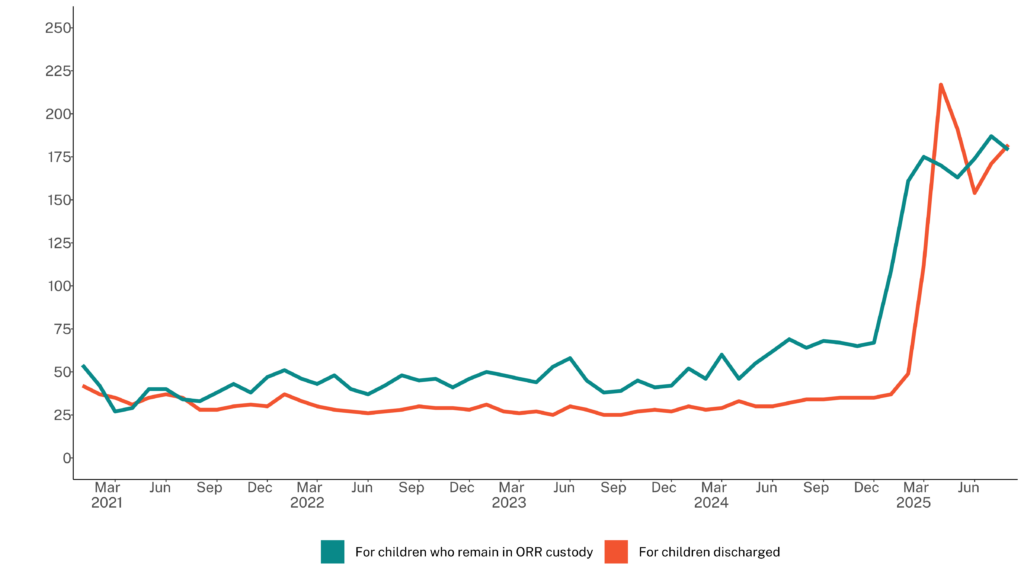
Coming into 2025, children spent about one month in ORR facilities before their discharge from custody (see Figure 1). But that duration soon increased substantially, reaching over six months in April 2025. As of the last day of August 2025—the most recent public data available—the approximately 2,000 children in ORR facilities had been there for an average of 179 days.
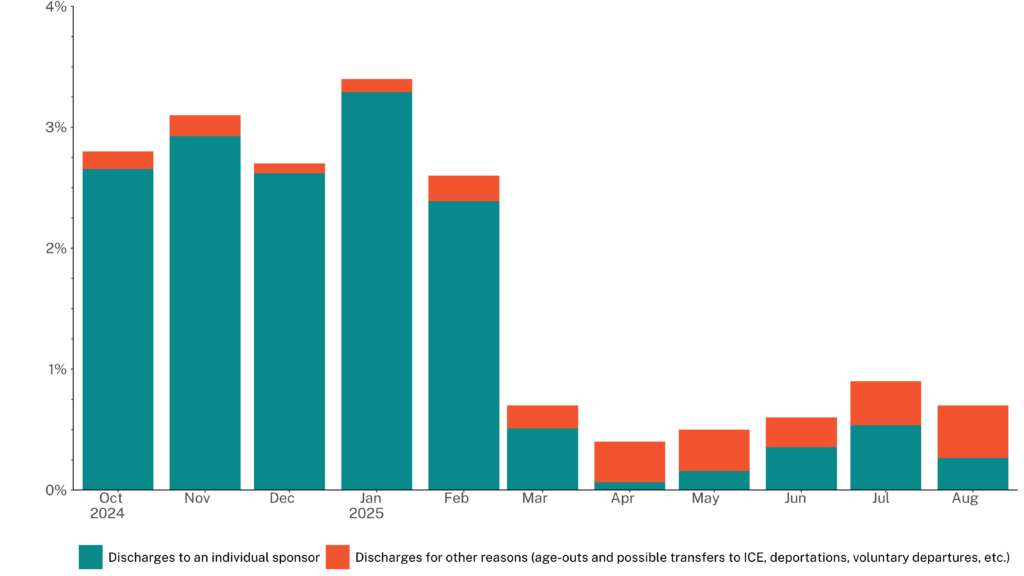
The sharp rise in children’s lengths of custody reflects a breakdown in ORR’s ability to place children in sponsors’ homes. Historically, ORR has discharged around 3 percent of the children in its custody on an average day (see Figure 2). However, this metric plummeted to 0.4% in April and has remained below 1 percent through August. Whereas it was previously common for between 100 and 200 children to be discharged from ORR’s facility network daily, that figure now rarely exceeds two dozen.
Figure 1. Unaccompanied Children’s Lengths of Custody in ORR Facilities
Monthly average days in custody, January 2021 – August 2025
Source: ORR Unaccompanied Alien Children Program data. Monthly data from the current fiscal year are available at acf.gov/orr/about/ucs/facts-and-data; data from prior years was posted previously and recorded by the authors.
The precipitous drop in children leaving ORR custody was also accompanied by a marked shift in the manner of children’s discharge. Whereas around 95% of discharged children have traditionally been placed in a sponsor’s home, between April and August 2025 this was the case for only 45% of discharged children (see Figure 2). That is, over half of the children discharged since April left ORR custody without the protection of a vetted family member or other sponsor being able to welcome the child into their home and agree to care for them for the duration of their immigration proceedings. Instead, these children only left ORR custody because they turned 18 and “aged out” of ORR facilities, were deported or otherwise returned to their country of origin, or for other reasons not involving placement with a sponsor.
Such sudden, massive changes—nearly a six-fold increase in children’s lengths of custody, and nearly an 80% decline in ORR’s discharge rate, since January 2025 —stand in stark contrast to the prior stability of ORR’s system for placing children with vetted sponsors. Under the Biden administration, that stability was rooted in nuanced policies: Straightforward cases could be approved more expeditiously. For many children, it was possible to be discharged from ORR custody considerably more quickly than the one-month average, such as certain children determined not to be especially vulnerable, who had an identified parent residing in the United States, and for whom there were no safety concerns. In fact, a comparison of ORR’s program to state child welfare systems highlights the speed with which children removed from their homes can be placed with other family members, concluding that “two to three weeks is a reasonable time for securing an immigrant child’s safe placement to family or to foster care.”ii
Policy Changes Prevent Discharges to Loving Homes
The sudden changes in children’s lengths of custody and ORR’s discharge rate coincide with a cascade of new policies that have created compounding barriers to children’s unification with a parent or other sponsor (see Appendix). Collectively, these policies represent a fundamental reorientation in how the government views potential sponsors: Those previously recognized as family members wishing to provide a loving home, clearly in a child’s best interests, are now targets of suspicion.
Percentage of Children in ORR Facilities Who Are Discharged Each Day
Monthly average discharge rate, by release type, October 2024 – August 2025
Source: ORR Unaccompanied Alien Children Program data. Monthly data from the current fiscal year are available at acf.gov/orr/about/ucs/facts-and-data. Monthly average discharge rates by release type are estimates derived from publicly available data. Documentation on how to replicate these estimates is available here.
Potential sponsors—even a child’s parent—may be hesitant to come forward because they fear they or their loved ones will be subjected to immigration enforcement based on ORR’s new policies. For instance, sponsors are now required to verify their identification in person with ORR, at meetings where they may be arrested by Immigration and Customs Enforcement (ICE).iii Moreover, ORR now requires fingerprinting from all of a sponsor’s adult household members, regardless of the relationship between sponsor and child, and regardless of whether safety concerns have been raised, which means household members may be required to risk being arrested due to status violations that are completely unrelated to child welfare concerns.iv These requirements, combined with increased information-sharing between ORR and ICE, have generated well founded anxiety about engaging with ORR’s sponsorship process.
For potential sponsors who do come forward, ORR’s new policies establish onerous requirements that are either impossible to meet or involve lengthy delays. Sponsors must now produce specific identification and income documents that many immigrants lack access to, effectively eliminating many who have strong family connections with the child and adequate housing. These new policies incorporate standards unrelated to their purported aim; for instance, sponsors may now only use foreign passports as proof of identity if they demonstrate legal residency or work authorization—neither of which are appropriate indicia of a sponsor’s ability to provide a safe, supportive home. Furthermore, ORR has imposed additional vetting requirements that have led to predictable processing bottlenecks, such as mandating DNA testing to confirm biological relationships without ensuring that children and sponsors are able to make timely appointments.
What makes these policy changes so devastating to the sponsor vetting process is that they create compounding barriers to a child’s release from custody. Even if a potential sponsor takes extraordinary steps to overcome one hurdle—such as by moving to a new residence without undocumented household members unwilling to provide their own personal information to the government—they will still have many more to climb. In some cases, ORR adds further unnecessary delay by addressing issues sequentially, such as by requiring a parent to complete all other aspects of their application before submitting a request for an exception to ORR’s new identification requirements, which can then add an additional month or more to the approval process.
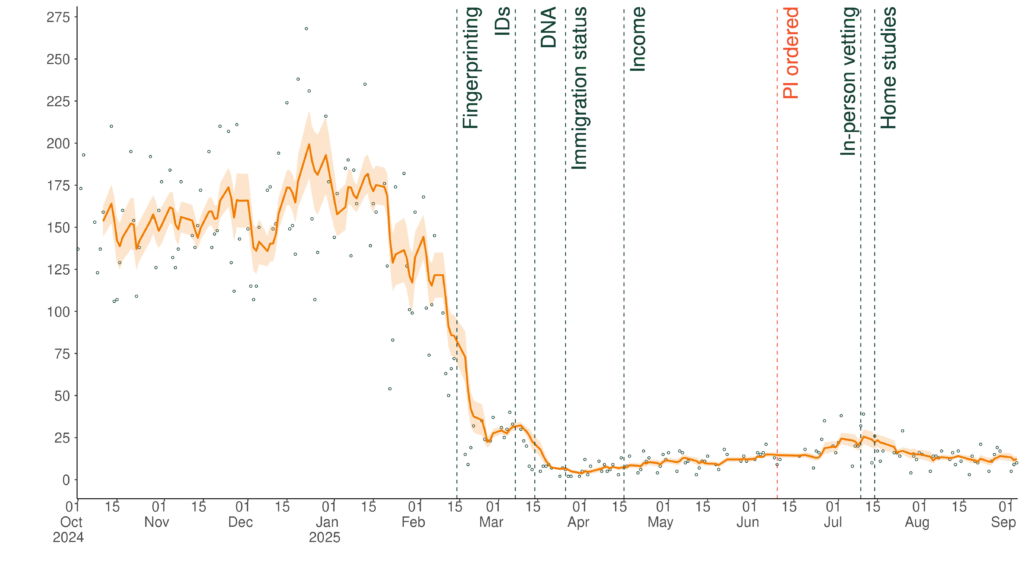
ORR’s public data clearly demonstrates the cumulative effect of these policies. By the beginning of March 2025, the total number of children discharged from ORR custody had dropped to around 30 per day (see Figure 3). As new requirements relating to proof of identity and DNA testing were introduced later that month, daily discharges dropped further, to only about a dozen per day. While discharges did not drop even more when subsequent policies related to sponsor vetting were introduced, that is because discharges to sponsors were already at floor—as low as they could possibly be.1 ORR’s data also suggests that lifting these policies can make a difference, facilitating children’s unifications with sponsors. Plaintiffs in the Angelica S. v. HHS litigation have challenged some of ORR’s new sponsor vetting policies as unnecessary and improperly constructed. On June 9, the judge in this case issued a preliminary injunction, ruling that the identification and income requirements would not apply to class members. Although the class was limited to only some children in ORR custody, soon after the injunction there was a small increase in discharges (see Figure 3). However, that increase was only temporary, as a few weeks later ORR not only issued its requirement for in-person sponsor vetting but also significantly expanded the circumstances in which a time-consuming home study would be required. After those new policies were established, total daily discharges returned to the extremely low levels they had been at prior to the injunction.
Figure 3. Discharges from ORR Facilities and Policy Changes Impacting Sponsor Vetting
Daily number of children discharged, October 1, 2024 – September 1, 2025
Source: HHS Unaccompanied Alien Children Program data available at healthdata.gov.
—
1 Daily discharge counts in Figure 3 include discharges of all types. As shown in Figure 2, there are discharges each day that do not involve release to a sponsor.
Harms to Children in ORR Custody Continue to Accrue
Each day an unaccompanied child spends in ORR custody increases the risk of lasting harm. Most have experienced trauma—in their countries of origin, during their migratory journeys, or even after entering the United States. This makes them articularly vulnerable and in need of child-centered, trauma-informed care.v Although many ORR facility care providers strive to do their best for children in custody, even the best-run facilities are no replacement for a loving family home and community-based supports.
As the American Academy of Pediatrics has warned, immigration detention is no place for any child.vi Children in ORR custody have often traveled great distances, fighting through incredible adversity, only to find themselves in a restrictive setting with unclear timelines for their discharge. As the days in custody go by, they can become hopeless. Not understanding the barriers to their release, they may also come to believe that a parent or family member residing in the United States does not want them. Some may even have already passed through ORR custody once, but found themselves swept up by immigration enforcement in the interior, ripped from their families, and returned to an ORR facility.vii And many fear for the well-being of family members who remain in their countries of origin.
All these experiences can be devastating to a child’s mental health, as well as their attachment with a parent or other caregiver, with potentially lifelong consequences.viii Children in ORR custody are vulnerable to severe anxiety, depression, post-traumatic stress disorders, and other serious conditions. Moreover, none of these issues resolve spontaneously upon discharge. Rather, the harms accrued in ORR custody layer upon all the other challenges faced by children lucky enough to be released to a sponsor, as they seek to build their new lives.
Lengthier periods of custody also increase the administration’s ability to force children into inappropriate or unlawful situations. ORR now allows ICE to interview children in ORR facilities without legal counsel present, and without guardrails to ensure children understand the interviews and are not misled as to their purpose.ix This is particularly concerning in light of the administration’s recent pushes for more children to be removed from the country through nonstandard means of dubious legality. First, Customs and Border Protection has begun asking unaccompanied children it encounters if they wish to elect voluntary departure, passing children who respond affirmatively directly to ICE for deportation.x Such handoffs bypass the Trafficking Victims Protection Reauthorization Act’s (TVPRA) protections requiring removals for certain children to be considered by an immigration judge.xi Second, the country witnessed the government’s middle-of-night efforts over the Labor Day Weekend to remove Guatemalan children from ORR facilities and repatriate planeloads of them,xii in violation of statutory protections and children’s rights to due process.xiii The common thread here is that when unaccompanied children are in the government’s custody they are under its coercive control—and that makes it easier for them to be mistreated and deprived of their rights.
Beyond these very real dangers, ORR’s new sponsor-vetting policies have stolen from children something precious. The extra weeks and months spent languishing in ORR custody are a missed opportunity for children to begin healing, to reconnect with family, and to experience childhood as a time of joy and possibility. Whether or not a child ultimately wins permission to remain in the United States is a matter to be decided by USCIS or immigration court. But in the meantime, unaccompanied children deserve a chance to live in a loving home, to go to school, to be part of their communities, to work through the hardships they have endured, and to dream of a safe and rewarding future.
Conclusion and Recommendations
ORR’s public data reveals a system that, while imperfect, once functioned effectively. We recommend two steps toward fixing this broken system.
First, ORR should re-center its policymaking on the proper balance between its obligations to vet sponsors and to avoid placing children in situations that are harmful. And it must recognize that immigration detention, including in ORR custody, hurts children. Policies governing children’s unification with a sponsor should focus squarely on whether a potential sponsor is able to safely care for the child during the pendency of their immigration proceedings, and ORR should seek to minimize the time children spend in custody while necessary vetting occurs. A return to nuanced vetting, which does not apply the same blanket policies to all potential sponsors, and which recognizes a parent’s or close family member’s special interest in a child’s well-being, is appropriate.
Second, ORR should commit to greater transparency on the effects of its policies. One area where additional sunlight would be particularly productive is for ORR to communicate to Congress and the American people what happens when children are discharged from its custody but not placed with an individual sponsor. ORR’s ongoing data reporting should include counts of children discharged for each release type. That would improve third-party oversight of concerning situations, such as children who may be electing voluntary departure just to escape detention. This reporting should also clarify whether children aging out of ORR custody are being transferred directly to ICE custody, rather than being connected to services to assist their integration into the community as they participate in their immigration proceedings.