
Report
Freeing Children, Reuniting Families: The Power of Habeas Advocacy
Executive Summary
Since the beginning of the second Trump administration, the length of time unaccompanied children spend in the custody of the Office of Refugee Resettlement (ORR) has ballooned, driven by increasingly cumbersome sponsor vetting processes and apparent organizational inefficiencies. As a result, children and their advocates have increasingly turned to a novel legal strategy to seek release—the filing of habeas corpus petitions to challenge unlawful confinement.
This report documents findings from the first systematic effort to understand this phenomenon, the contexts that push children and those who care about them to this rarely used measure, and the impact it is having. To do so, we analyzed publicly available court filings of unaccompanied children’s cases and observed the unfolding of the Children’s Due Process Project—a grassroots effort to increase capacity for filing habeas petitions on behalf of unaccompanied children nationally. Through our analysis of habeas petitions filed on behalf of unaccompanied children, we found:
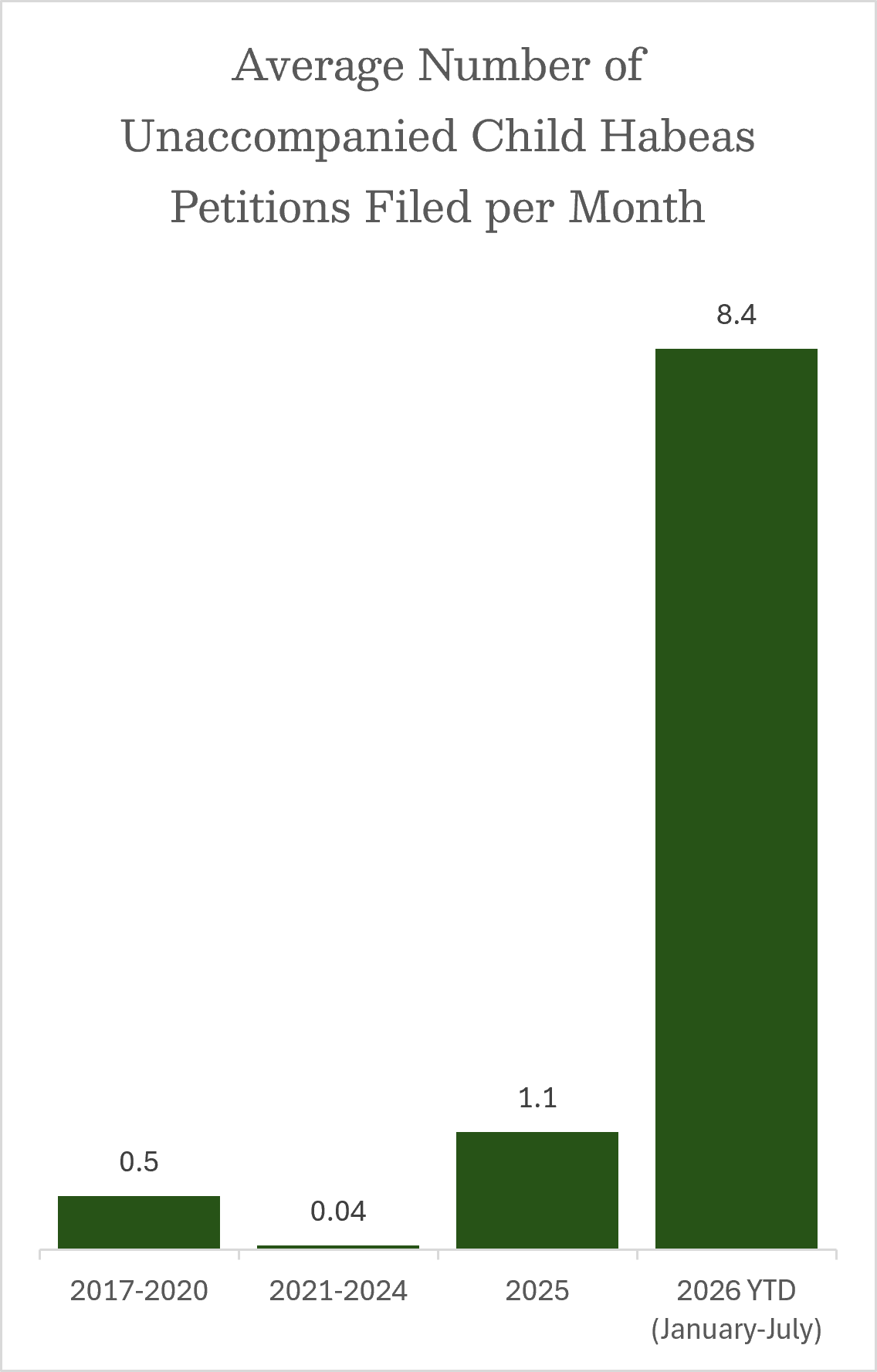
- A dramatic rise in the use of habeas as a means of garnering children’s release from ORR custody, with a 3,500% increase in habeas filings on behalf of unaccompanied children between January 2025 and July 2026 compared to all filings between 2021-2024. If the current pace is maintained, over 100 habeas petitions on behalf of unaccompanied children will be filed in 2026 alone.
- Petitions have been filed in 16 federal jurisdictions, but over 70% of petitions are concentrated in just four jurisdictions. This uneven geography is likely reflective of variations in where children are detained and uneven access to attorneys with the licensure, expertise, and resources needed to pursue habeas.
- Petitions are almost always successful at garnering children’s release from custody, with 98% of the cases reviewed resulting in the release of the child from ORR custody.
- Short timelines between filing of habeas petitions and children’s release point to apparent shortcomings in ORR’s management of sponsor vetting and release. 80% of cases reviewed resulted in children being released in 30 days or less and court documents reveal numerous examples of ORR mismanagement in sponsor vetting that are linked to children’s prolonged detention.
- The actions of federal agencies are creating unaccompanied children and then trapping them in prolonged detention. We identified at least four cases in which a child who was never previously designated an unaccompanied child and previously under the care of a parent or guardian in the United States, was designated an unaccompanied child by federal agencies following interior enforcement efforts and then experienced prolonged detention in ORR custody.
- Patterns of re-detention and re-vetting are resulting in the unnecessary and prolonged detention of children. This is shockingly prevalent; of cases in which information about the detention context was available, 1 in 3 involved a child being re-detained for a prolonged period due to re-vetting of their sponsor. Re-vetting is not legally required and undermines the child welfare provisions of existing laws and policies.
Our findings suggest that policy changes could substantially reduce the amount of time children spend in ORR custody, improving outcomes for children and obviating the need for habeas petitions. We recommend that ORR implement changes to their sponsorship policies and procedures, including:
- Eliminating unnecessary sponsor vetting processes and arbitrary expiration dates which do not increase safety and are not required by law;
- addressing internal mismanagement and poor communication which contribute to prolonged detention times;
- ensuring access to qualified legal counsel who can support and advocate for children throughout their time in detention; and
- releasing children who are re-detained to their previously approved sponsors without unnecessary re-vetting.
We additionally recommend that federal immigration enforcement agencies avoid separating children from parents and other caregivers—including by detaining those parents and caregivers—which often results in children being unnecessarily designated unaccompanied and detained by ORR. Congress can contribute to a solution by prohibiting sharing information about children and sponsors with immigration enforcement agencies. And state and local governments and philanthropic organizations can fund legal services for both removal defense and habeas petitions for children, which are critical interventions while the unnecessary and prolonged detention of children in ORR custody persists.